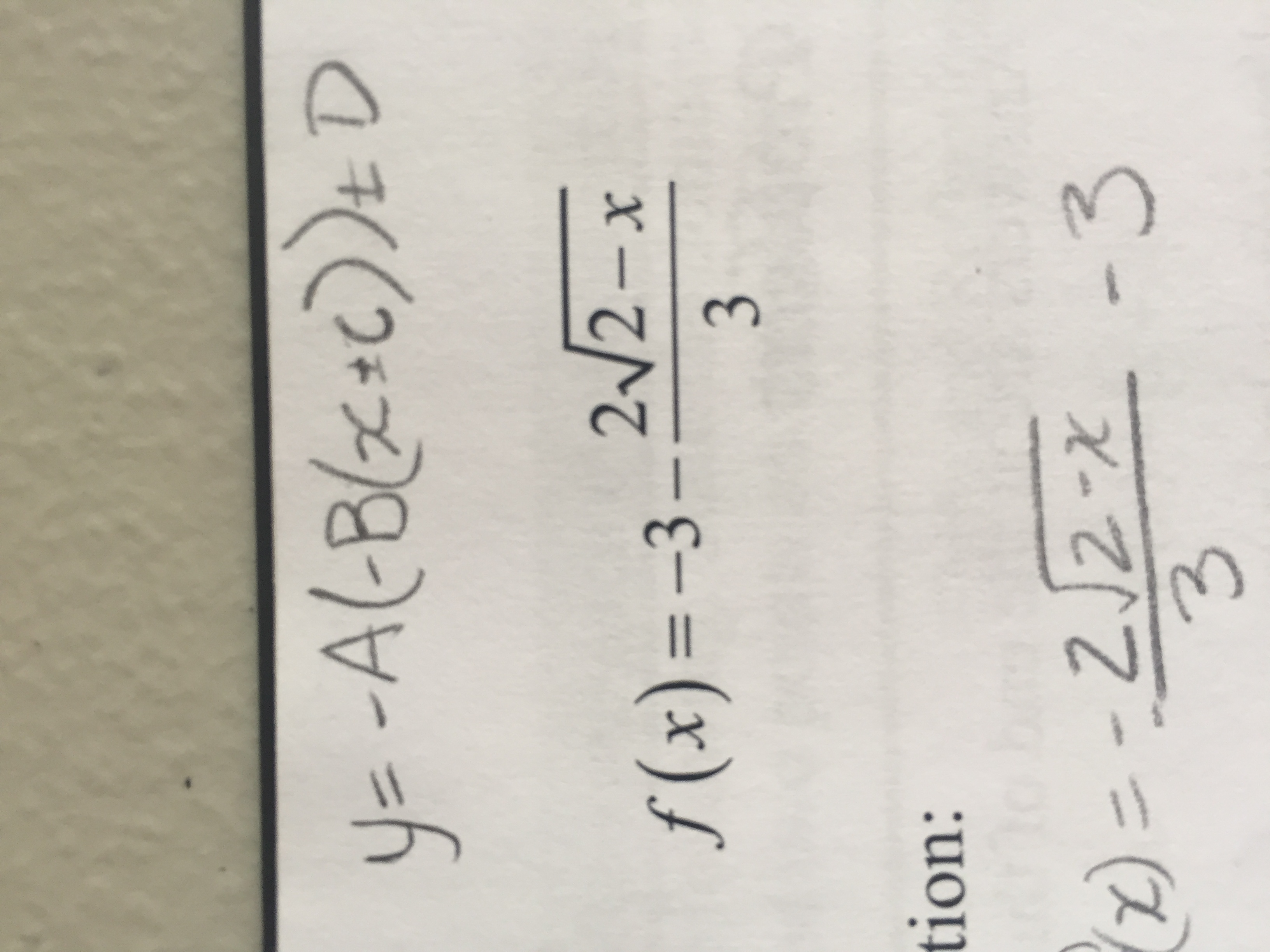
Help with transformation of functions
I have come across this question in my math class and it appears that I am able to solve for the x intercept however the graph doesn't seem to have one.

Could someone explain this to me?
I have come across this question in my math class and it appears that I am able to solve for the x intercept however the graph doesn't seem to have one.

Could someone explain this to me?
I think this discrepancy could be because of an extraneous root. The way that I am looking at this function, the value will always be negative, never zero (x-intercept) or positive. But if you tried solving for the value of x when f(x) is zero, I'm guessing that you went through the following steps:
0 = -3 minus the rest
3 = negative of the rest
9 = the rest squared = (4*(2-x))/9
81 = 8-4x
73 = -4x
-73/4 = x
However, if you set x = -73/4 in the function above, f(x) = -6.
Set y equal to 0:
0 = -3 - (2root(2-x)) / 3
Add 3 on both sides:
3 = -(2root(2-x)) / 3
Multiply 3 on both sides:
9 = -2root(2-x)
Divide by -2 on both sides:
-9/2 = root(2-x)
The square root of a number cannot be negative, so there is no solution for y=0
Opslag er lukket for kommentarer.